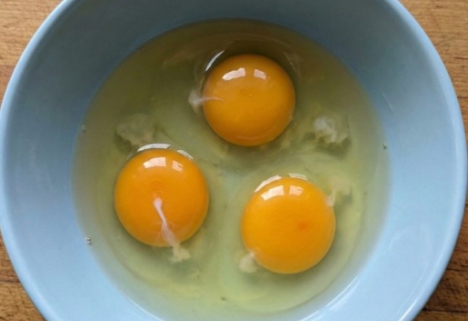

You crack open an egg—and there it is: that weird, white, stringy blob clinging to the yolk.
For years, you might’ve thought it was a flaw, a leftover bit of… something best discarded. Maybe you even scooped it out like it was a mistake nature made.
But here’s the truth: that “white stuff” is not only normal—it’s a sign of freshness! And it has a name that sounds like it belongs in a Mediterranean bistro: the chalaza (pronounced shuh-LAY-zuh).
What Exactly Is the Chalaza?
The chalaza (from the Greek word for “little knot”) is not an embryo, not a blood spot, and definitely not a parasite.
It’s a natural, edible part of the egg—made of twisted protein strands—and its job is simple but vital:
To keep the yolk centered in the egg white.
Think of it as nature’s suspension system. Without the chalaza, the yolk would drift and bump against the shell, risking damage—especially important if the egg were ever fertilized and developing into a chick.
Why Are There Two?
Most eggs actually have two chalazae—one at each end of the yolk—anchoring it like a hammock inside the egg white (albumen). When you crack an egg, you usually see one more prominently than the other.
Does It Mean the Egg Is Fresh?
✅ Yes! The more visible and firm the chalaza, the fresher the egg.
As eggs age, the chalaza loosens and becomes less noticeable. So if you see a strong, ropey chalaza? That’s a good thing!
Should You Remove It?
Should You Remove It?
Not unless you’re making something ultra-smooth, like:
Custard
Hollandaise sauce
Angel food cake
Fine pastry cream
In those cases, chefs sometimes strain it out for texture—but it’s 100% safe to eat. In scrambled eggs, omelets, or fried eggs? Leave it in! It disappears when cooked.
🍳 Fun fact: The chalaza contains the same protein as egg white—just more concentrated.
What It’s NOT (Common Myths)
❌ Not a baby chick – Unfertilized eggs (which are all store-bought eggs in the U.S.) can’t develop into chicks.
❌ Not a sign of spoilage – It’s present in every healthy egg.
❌ Not harmful – Totally edible and nutritious.
The Bottom Line
Next time you see that “white squiggle,” don’t scoop it out in fear.
Celebrate it! It’s proof your egg is fresh, whole, and perfectly designed by nature.
So go ahead—cook it, scramble it, fry it. That chalaza? It’s just doing its quiet, anchoring job… right up until your first delicious bite.
“Nature doesn’t make mistakes. Sometimes, it just makes things we don’t understand yet.”
Have you ever removed the chalaza? Will you leave it in next time? Share your egg thoughts below—we’re all cracking the code together! 🥚✨